


- Joined
- Apr 5, 2024
- Messages
- 144
- Points
- 28
Most small businesses don’t think they’re interesting enough to be targeted on the dark web. That’s exactly what makes them such easy targets.
Cybercriminals don’t discriminate by company size. They target volume. And right now, millions of small business credentials, employee email addresses, VPN logins, and customer records are circulating in underground marketplaces and dark web forums, quietly available to anyone willing to pay a few dollars for them.
The difference between a company that catches this early and one that finds out after the damage is done almost always comes down to one thing: whether they had a dark web monitoring tool in place.
This guide covers the 15 best dark web monitoring tools available to small businesses in 2026, including what each one does well, what it doesn’t, and which type of business it suits best. We’ve organized this list with small business usability, affordability, and practical coverage in mind. No enterprise-only platforms that require a dedicated security team to operate.
What to Look for in a Dark Web Monitoring Tool
Not all dark web monitoring tools are built for small businesses. Before comparing individual products, here’s the framework you should use:- Coverage breadth — Does the tool monitor Tor-based forums, paste sites, Telegram channels, stealer log repositories, and dark web marketplaces? Or just recycled public breach databases? The gap matters enormously.
- Monitoring frequency — Real-time or near-real-time crawling is fundamentally different from daily batch updates. A tool that checks once a day can miss a 12-hour window where credentials are actively exploited.
- Alert quality — Quantity of alerts isn’t the metric. You want precise, contextualized, actionable alerts that tell you exactly what was found, where, and what to do. Alert fatigue from a noisy tool is almost as bad as no monitoring at all.
- Ease of use — Small businesses are unable to support the services of an analyst; therefore, the appropriate tool for SMB should display results in a plain, non-technical language that dictates in no uncertain terms, exactly what the next step for remediation is.
- Pricing that scales — Enterprise pricing models that charge per-seat or per-asset at high rates are a poor fit. Look for flat-rate or tiered pricing that makes sense at 5–50 employees.
- Breadth of monitored assets — Can you monitor your company domain, employee emails, executive PII, and brand name, not just one email address?
Best 10 Dark Web Monitoring Tools for SMBs
1. Have I Been Pwned (HIBP)
Best for: Free baseline check for individuals and very small teams
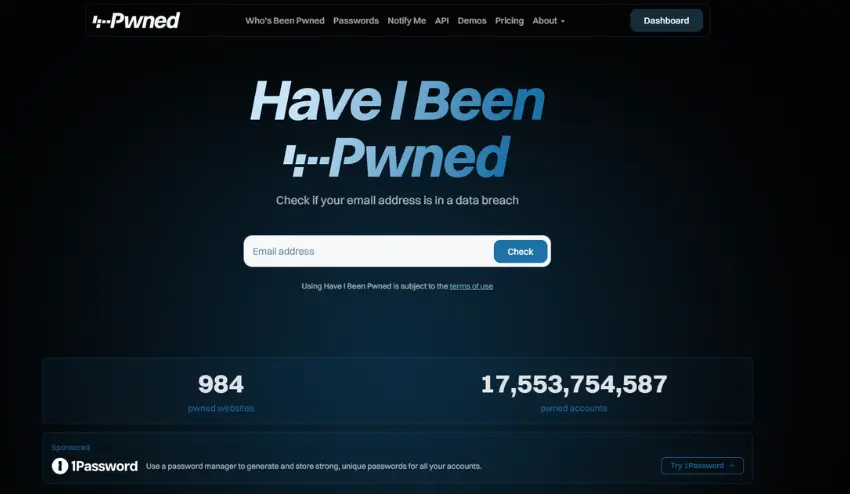
Have I Been Pwned, built by security researcher Troy Hunt, is the most widely referenced breach database available. Any individual can check whether their email has appeared in a known public breach for free. For businesses, the Domain Monitoring feature lets you verify whether any address under your domain appears in HIBP’s database.
The core limitation is transparency about what it covers. HIBP tracks publicly disclosed breach datasets, not live dark web activity, stealer logs, or private forum dumps. It’s a historical snapshot, not continuous monitoring. But as a free starting point to understand your baseline exposure, nothing beats it.
Strengths: Free, trusted, zero setup, excellent breach transparency
Limitations: Not real-time, no coverage of stealer logs or live dark web sources, no alerting
Best for: Solopreneurs, freelancers, very small teams doing a first-time exposure check
Pricing: Free for individuals; Domain Search is free for verified domain owners
2. Flare
Best for: Mid-size SMBs that want comprehensive dark web coverage without analyst overhead
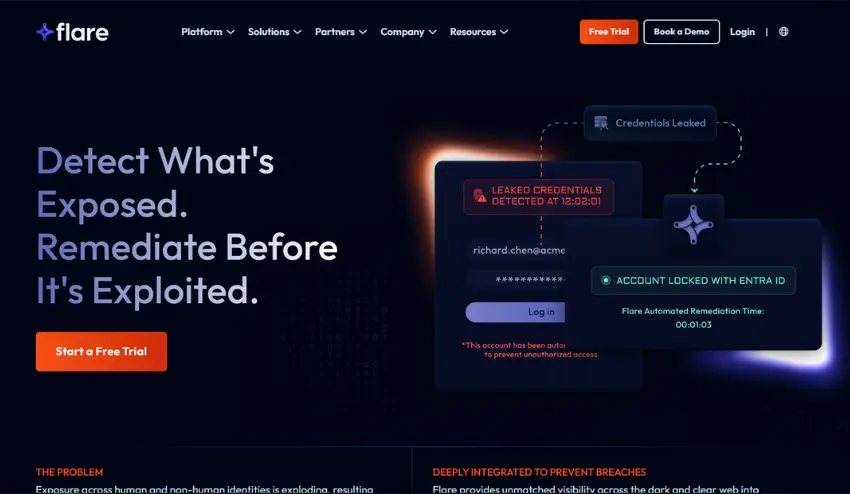
Flare scours over thousands of dark web sources, including stealer logs, Telegram channels, forums, and criminal marketplaces. Flare differentiates itself in the way it automates threat detection and prioritization, making it a practical solution for companies with few or no expert threat intelligence analysts.
Flare supports its extensive data scraping with AI-powered threat summaries and natively integrates its alerts with systems such as Splunk, Jira, and Microsoft Sentinel. For a growing small business with some IT resources, Flare provides serious coverage with manageable operational complexity.
Strengths: Wide source coverage, monitoring for stealer logs, robust alert customization, functional workflows
Limitations: Configuration can be complex when compared to consumer-level SMB tools; it might prove a challenge for very small organizations.
Best for: Organizations of 20-100 employees that have an IT or security person at least partially on staff
Pricing: Pricing on request, positioned to serve the mid-market
3. DarkScout
Best for: Small businesses that require inexpensive, constant dark web monitoring with AI-based clarity
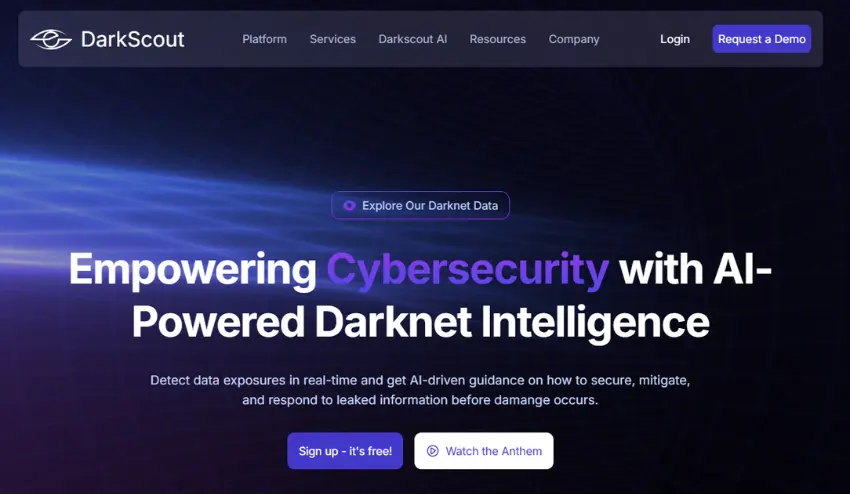
DarkScout is an AI-based security intelligence platform for individuals, small businesses, and enterprises that require external exposure to be constantly monitored without the price and complexity of enterprise security products.
Where most dark web monitoring tools either underserve small businesses with consumer-grade products or overcharge them with enterprise pricing, DarkScout sits squarely in between, delivering genuine darknet coverage with an interface that doesn’t require a security analyst to operate.
The platform monitors across dark web sources, stealer log repositories, Telegram channels, paste sites, and underground forums, then uses AI to translate findings into clear, actionable intelligence with remediation steps. Features include Credential Watch and Breach Detection, Attack Surface Mapping, and Email Security Intelligence, all accessible from a unified dashboard.
A key differentiator for small businesses: DarkScout’s AI-powered explanations mean that even non-technical business owners can understand exactly what was found and what to do about it. No jargon. No decoding required.
DarkScout also offers a free email scan and free website scan, useful for a quick first look at your exposure before committing to a paid plan.
Pros: Purpose-built for SMBs, AI explanations, constantly monitoring, scalable at low prices, and a central dashboard for surface and dark web. Has some free services.
Cons: not focused as much on the deeper geopolitical threat intelligence like the enterprise-level platforms.
Good for: small businesses (1-200 people) that require meaningful dark web coverage but do not want the complexities or enterprise pricing.
Price: starts free, tiered according to the number of emails/domains/team members monitored-see pricing.
4. SpyCloud
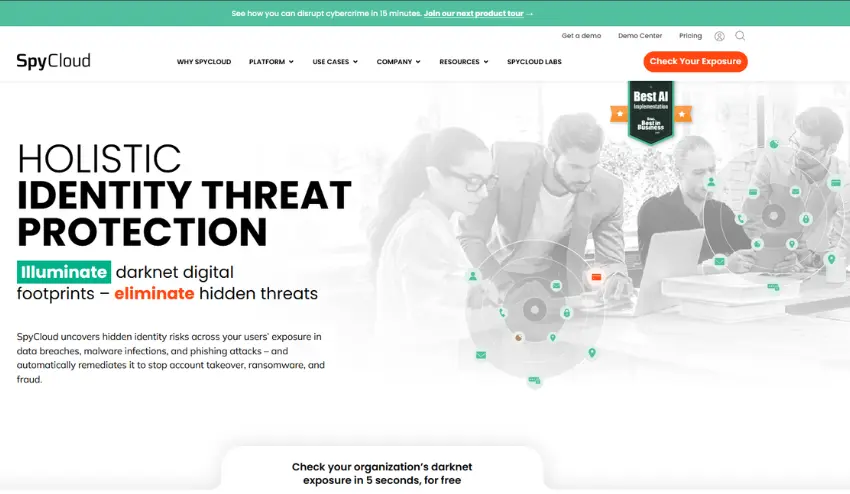
Best for: Organizations with an emphasis on credential exposure and account takeover prevention
SpyCloud collects and monitors the credentials, session cookies, and identity information that have been recovered from malware-infected devices – often before the data enters the public dark web. Its primary strength is early-stage discovery, whereby compromised credentials are found nearer to the point of theft and weeks, not months, after being used.
SpyCloud has automated remediation features, whereby it can prompt for password resets and disable compromised accounts. This is particularly useful if the company’s main concern after a compromise is lateral movement by the threat actors. It fits nicely into current identity and access management (IAM) workflows.
Strengths: Huge, collected credential corpus, early-stage detection, automated remediation capabilities, excellent IAM integrations
Weaknesses: Relatively limited on wider threat intelligence data, tends towards enterprise pricing, suited more towards the security mature
Ideal for: SMB with mature security operations and an immediate need to curb credential theft and account takeovers
Price: contact for pricing; pricing structure leans mid-tier to enterprise.
5. Dark Web ID (Kaseya / ID Agent)
Best for: Managed service providers (MSPs) protecting multiple small business clientsDark Web ID, now part of the Kaseya ecosystem, was built specifically for MSPs — IT service providers that manage security for multiple small business clients simultaneously. It provides 24/7 human and machine-powered monitoring of business and personal credentials, scanning underground forums, marketplaces, and breach dumps.
The MSP focus is both its strongest feature and its clearest limitation. If you’re running an MSP, the prospecting tools, reporting, and white-label features are genuinely useful. If you’re a standalone small business rather than a managed services customer, you’ll likely be interacting with this through your IT provider rather than directly.
Strengths: Purpose-built for MSP use cases, human + automated monitoring, strong reporting, Kaseya platform integration
Limitations: Direct access is not ideal for standalone SMBs without an MSP relationship
Best for: Small businesses using an MSP for IT management; MSPs themselves
Pricing: Through Kaseya partners; contact for direct pricing
6. Recorded Future
Best for: Businesses with complex threat intelligence needs and dedicated security resourcesRecorded Future is one of the most comprehensive threat intelligence platforms available, with dark web monitoring as one component of a much broader intelligence ecosystem. It tracks threat actors, malware operations, vulnerability exploitation, and dark web activity — synthesizing data into predictive intelligence.
For a small business without a dedicated security analyst, Recorded Future is genuinely overkill. The platform delivers extraordinary depth but requires people with the expertise and time to act on what it surfaces. That said, for SMBs in regulated industries or those handling sensitive data at scale, the investment may be justified.
Strengths: Breadth and depth unmatched, predictive abilities, and deep integrations.
Limitations: High learning curve, extremely expensive, necessitates in-house security experts to truly benefit.
Best for: Small businesses with mature security needs, high-risk industries; better at mid-market/enterprise.
Pricing: Enterprise pricing is contact required; a significant investment.
7. SOCRadar
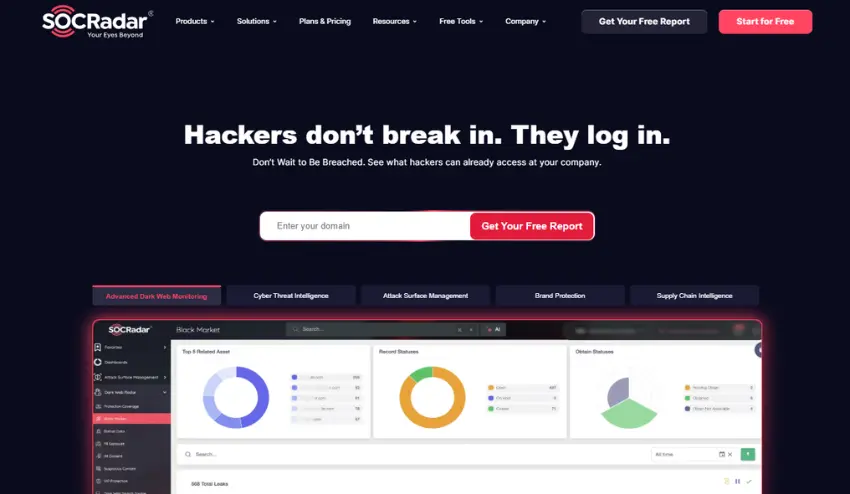
Best for: SMBs wanting integrated threat intelligence with dark web monitoring
SOCRadar is a SaaS cybersecurity platform that combines dark web monitoring with broader external threat intelligence, brand protection, attack surface monitoring, and vulnerability intelligence in one platform. It’s been growing steadily since 2019 and now serves customers across more than 75 countries.
The platform is reasonably accessible compared to pure enterprise tools, and the dashboard gives security teams a consolidated view of external risk. Alert quality is a noted weakness in some user reviews; the system can generate noise, but the overall coverage and price point make it a viable option for security-conscious SMBs.
Strengths: Broad coverage, SaaS delivery, combines dark web and surface web monitoring, and reasonable SMB accessibility
Limitations: Alert system can be noisy, some features lean towards enterprise
Best for: SMBs with an IT team that wants integrated threat intelligence beyond just dark web monitoring
Pricing: Tiered; contact for SMB pricing
8. Panda Dome
Best for: Very small businesses and non-technical users wanting simple all-in-one protectionPanda Dome bundles antivirus, privacy protection, and dark web monitoring in a single consumer-friendly platform. The Dark Web Monitor runs continuously in the background and alerts users if their email appears in breach databases or underground markets.
It’s not a sophisticated enterprise solution; it monitors by email address rather than organizational domain and doesn’t provide stealer log coverage or deep forum intelligence. But for a solo professional, a five-person team, or a business owner who wants protection without complexity, the combination of endpoint protection and basic dark web alerting in one subscription has genuine appeal.
Strengths: Easy to use, all-in-one with antivirus, affordable, no technical expertise required
Limitations: Email-only monitoring, no domain-level coverage, limited dark web source depth
Best for: Solo professionals, micro businesses, non-technical users
Pricing: Multiple tiers; Panda Dome Premium includes dark web monitoring
9. Intruder
Best for: SMBs wanting combined vulnerability scanning and dark web monitoringIntruder provides vulnerability scanning for internet-facing systems alongside basic dark web monitoring, making it an interesting choice for small businesses that want to address both their external attack surface and dark web exposure in one tool.
The vulnerability scanning is the primary product, with dark web monitoring as a complementary feature. Clear, actionable alerts that don’t require a security team to interpret are a noted strength. It won’t replace a dedicated dark web intelligence platform, but for a small business starting to build security fundamentals, the combination makes practical sense.
Strengths: Ease of use, dual vuln/dark web coverage, straightforward alerts, works with SMBs
Weaknesses: Not a pure dark web tool; lacks depth when compared to dedicated platforms
Ideal for: SMBs who are looking to begin security basics before committing to specialized tools.
Pricing: Subscription-based; affordable for SMBs
10. Cybersixgill
Best for: Security teams that want real-time dark web intelligence from closed and deep communitiesCybersixgill uses a different method to acquire data – it operates in real time within the dark web forums and communities to gather actionable and truly up-to-date intelligence. It does not scan indexed, publicly-accessible data breach dumps, instead immersing itself within underground forums. In doing so, security teams will be alerted to a developing threat before the mainstream is aware.
The obvious benefit here is advance warning for an organization to respond to a threat that will specifically target them, but an organization must be well-trained to gain value from this sort of data, which would be difficult to achieve for an SMB with limited security talent.
Strengths: Real-time dark web intelligence, access to genuine underground communities, early threat detection
Weaknesses: Security talent required to maximize effectiveness, not optimized for self-service within the SMB space
Suitable for: Security-mature SMBs or high-risk entities, such as financial and healthcare industries
Pricing: Price upon application